
Law XIV:
The Law of Reflection
The universe mirrors the observer; every outer image reveals an inner state.
Essence of the Law
The universe mirrors the observer; every outer image reveals an inner state. Knowing oneself, one knows the world, for perception is the glass through which the soul beholds creation.
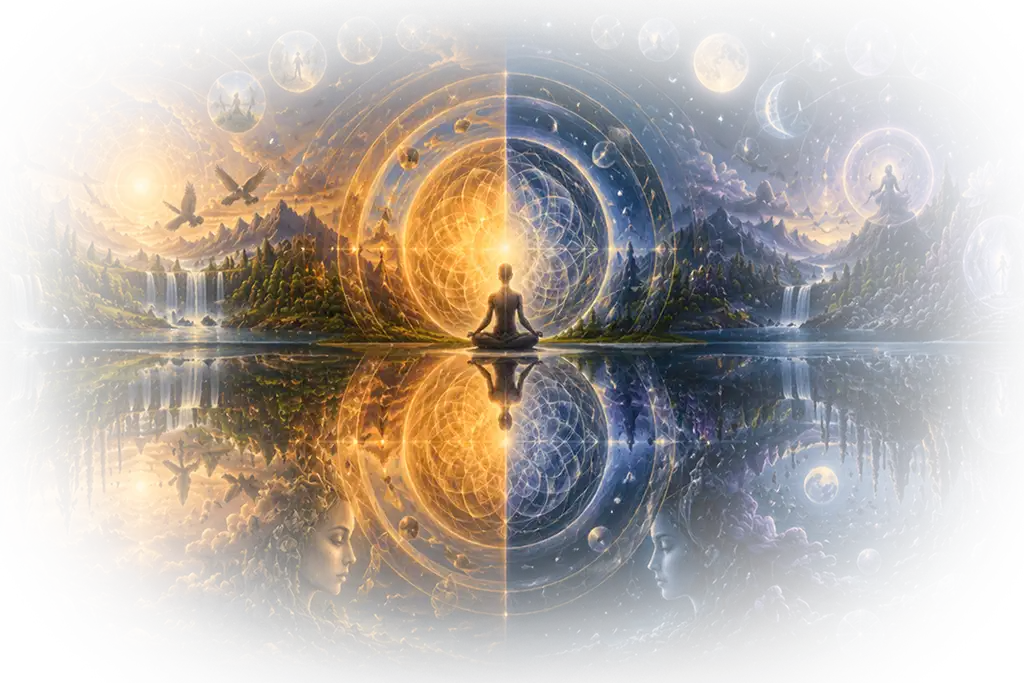
Law Overview
The Law of Reflection teaches that the world is encountered through the condition of the perceiving soul. What is seen outside often reveals what is active, wounded, hidden, feared, desired, or illumined within.
This law does not mean that every outer event is personally caused by the observer. Rather, it teaches that interpretation, reaction, attraction, repulsion, and recognition are mirrors. The world becomes a sacred surface upon which the soul may discover itself.
To practice this law is to polish the mirror of consciousness. The seeker observes reactions, purifies motive, refines perception, and learns to behold the Divine shining through every reflection.
Historical, Civilizational, and Comparative Analysis
Ancient Roots
Egyptian
In Egyptian symbolism, purification permits true vision. The face of Ra is seen only in the purified mirror, suggesting that divine light is not absent from creation, but obscured by the unrefined surface of perception.
Greek
In Alcibiades I, associated with the Platonic tradition, self-knowledge is approached through the image of soul beholding soul. Plato presents knowing oneself as a sacred philosophical act, where the inner eye learns to recognize its own image.
Vedic
The Katha Upaniṣad likens the realization of the Self to a face seen clearly in a pure surface. When the mind is calm, the Self is reflected without distortion.
Pagan Echoes
In magical practice, the mirror is a tool of revelation. The Key of Solomon and later grimoire traditions preserve the mirror as an instrument for scrying, vision, and disciplined seeing.
The magical mirror does not create truth from nothing; it reveals what is already present in the subtle field, including what lives in the heart of the practitioner.
Eastern Echoes
Zen and contemplative traditions often speak of the world as a mirror of mind. When the heart is restless, the world appears restless; when the heart is clear, the same world may become transparent to peace.
“The world is your mirror; when you are peaceful, it is peaceful.”
Zen Koan Collection
Esoteric Echoes
In Johann Wolfgang von Goethe’s Theory of Colours, perception is not treated as a passive recording of the world, but as an active encounter between light, darkness, eye, and soul.
“The perception of the world depends on the color of the glass.”
Goethe, Theory of Colours §14
Christian Echoes
Christian scripture speaks of present perception as partial and veiled. The soul sees through a glass darkly until divine knowledge clarifies vision and the mirror becomes face-to-face encounter.
“For now we see through a glass, darkly.”
1 Corinthians 13:12
Notes on Usage, Application, and Practice
Observe Reactions
Polish the Mirror
Behold the Divine
Recognize God shining through every reflection. Let every face, event, wound, and beauty become a mirror in which the sacred may be glimpsed.
Quotes and Key Statements
Egyptian: “The face of Ra is seen only in the purified mirror.”
Book of the Dead, Spell 17
Greek: “The soul perceives in others the image it carries within.”
Vedic: “As a face is seen in a clear lake, so the Self is seen in the mind.”
Katha Upaniṣad II.3.9
Western: “The perception of the world depends on the color of the glass.”
Goethe, Theory of Colours §14
Christian: “For now we see through a glass, darkly.”
Representative and Definitive Sources
Katha Upaniṣad II.3.9
First Epistle to the Corinthians, King James Version
A Platonic source for self-knowledge, soul, and reflective recognition.
Theory of Colours, Johann Wolfgang von Goethe
A Western source for perception as an active encounter between observer and world.
Contemplative Exercise
Choose one person or situation that strongly affects you. Write what you perceive, then write what you feel, then write what this may reveal about your own inner state.
Ask: What am I seeing clearly? What might I be projecting? What virtue would polish this mirror and allow truer perception?
Literature, Film, Music, and Cultural References
Literature
Through the Looking-Glass by Lewis Carroll
A literary journey through mirrored reality, inversion, identity, and symbolic perception.
The Picture of Dorian Gray by Oscar Wilde
A moral and aesthetic mirror of hidden corruption, beauty, conscience, and the divided self.
The Mirror and the Lamp by M. H. Abrams
A major critical work contrasting art as reflection and art as inner illumination.
Film
A dark cinematic mirror of sin, judgment, obsession, and the projection of moral corruption.
A film of perception, hidden truth, grief, and the revelation that changes how all prior images are understood.
Music
Michael Jackson, “Man in the Mirror”
A song of self-examination, moral reflection, and transformation beginning within.
A modern love song using reflection as an image of recognition, complementarity, and shared identity.
Law XIV:
The Law of Reflection
The world is a mirror, the heart is a glass, and the Divine is the light by which all reflections are known.