
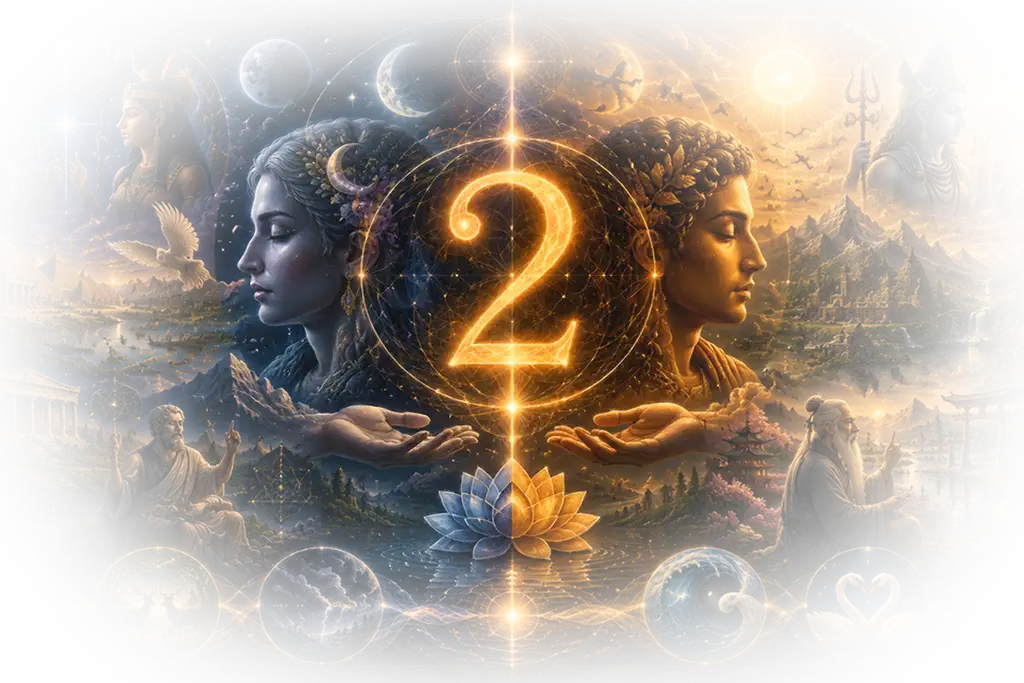
Number TWO
Duality, Reflection, Polarity, Relationship
The first differentiation from unity: polarity, relational awareness, reflection, tension, and the possibility of harmony.
Essence of the Number Two
Two represents the first differentiation, polarity, and relational awareness. Where One is undivided unity, Two is the birth of contrast: light and dark, heaven and earth, male and female, self and other. It is both the source of tension and the foundation of harmony.
Origins & Early Use ~ The Number Two
The concept of “two” is as ancient as counting itself, appearing in tallies, lunar cycles, paired deities, complementary forces, and mythic oppositions. It symbolizes duality in balance, opposition as creation, and the dynamic interplay that generates phenomena.
Mathematically, 2 is the first even number. In Pythagorean philosophy, it was associated with the Dyad, matter, receptivity, reflection, and the first movement away from the Monad.
Sacred Writings & Sources by Civilization
Ancient Egypt
Cosmic Pairs
Egyptian cosmology was structured through sacred pairings: Upper and Lower Egypt, Isis and Osiris, Ra and Ma’at, life and death. The Two Lands reflected divine order through dual governance, each side dependent upon the other.
Study Focus
Concept
Heaven and Earth were separated so creation could exist.
Mesopotamia
Sacred Marriage & Complementary Powers
Mesopotamian gods often appear in complementary pairs: Anu as sky and Ki as earth, Ea as wisdom and water with Damkina. Male and female principles balance creative energies.
The sacred marriage, or hieros gamos, unites heaven and earth through ritualized duality.
Study Focus
- Enuma Elish
- Sumerian Hymns
- Inanna-Dumuzi Myths
Greece & Rome
The Dyad, Matter & Opposition
The Pythagoreans regarded 2 as the Dyad, the principle of diversity, matter, multiplicity, and differentiation from the Monad. Plato explored dualism between the world of Forms and the world of matter, while Heraclitus treated opposites as generative forces of harmony.
Study Focus
- Timaeus by Plato
- Metaphysics by Aristotle
- Fragments of Heraclitus
Celtic Traditions
Land, Sea, Sun & Moon
Celtic symbolic systems preserve sacred dualities of Sun and Moon, Land and Sea, King and Goddess. Paired deities and elements express balance within the natural and mythic worlds.
Study Focus
Norse Traditions
India & Hinduism
Spirit, Matter, Consciousness & Energy
In Sāṃkhya philosophy, Purusha and Prakriti form the dual foundation of existence: spirit and matter. Shiva and Shakti embody consciousness and energy as complementary unity.
Study Focus
- Bhagavad Gītā, chapter 13
- Sāṃkhya Kārikā
- Shiva Purana
Buddhism
Transcending the Pairs of Opposites
Buddhism often treats duality as illusion or conditioned perception. Nirvāṇa transcends opposites such as pleasure and pain, birth and death, self and other.
Study Focus
- Dhammapada, especially the “Pairs” chapter
- Heart Sutra
China & Daoism
Yin and Yang
Yin and Yang are among the most enduring symbols of sacred duality. Yin is dark, receptive, female, and earthly; Yang is bright, active, male, and heavenly. Harmony arises not by destroying opposition, but by balancing it.
Study Focus
- Tao Te Ching, chapters 2 and 42
- I Ching
Japan & Shintō
Judaism
Creation, Inclination & Moral Choice
Judaism preserves sacred dualities in creation: heaven and earth, light and darkness, male and female. Human moral life is shaped by the coexistence of Yetzer Ra and Yetzer Tov, the evil and good inclinations, through which free will becomes meaningful.
Study Focus
Christianity
Heaven and Earth, Light and Darkness, Divine and Human
Christianity expresses duality through Heaven and Earth, God and Creation, light and darkness, good and evil, the Old and New Testaments, and the two natures of Christ: divine and human.
Key Scriptures
- Matthew 6:24 — “No one can serve two masters.”
- Genesis 2:24 — “The two shall become one flesh.”
- Ephesians 5:31
- John 1
Study Focus
Islam
Pairs Within Divine Unity
The Qur’an repeatedly describes creation in pairs. Duality is not ultimate opposition, but complementarity under divine unity. Male and female, night and day, life and death all mirror the completeness of God’s creative order.
Study Focus
Africa
Twins, Fertility & Cosmic Repair
In Yorùbá cosmology, the twin Ibeji symbolize balance, blessing, fertility, and sacred duality. In Dogon cosmology, the twin Nommo spirits express cosmic dual order, including sacrifice and restoration of balance.
Study Focus
- Odu Ifá, especially Ibeji verses
- Conversations with Ogotemmêli
Australia & Aboriginal Traditions
Paired Beings in the Dreaming
Many Dreaming stories feature paired beings such as brothers, sisters, or serpents who create through cooperation, conflict, movement, and transformation. Duality is not abstract opposition but relational action within Country.
Study Focus
- Rainbow Serpent traditions
- Songline oral histories
Definitive Sources for Study of Number Two
Philosophical
- Fragments of Heraclitus — opposition as unity.
Mystical & Mathematical
- The Pythagorean Sourcebook and Library — Dyad doctrine.
Scriptural
- Genesis 1–3 — dual creation.
- Tao Te Ching, chapters 2 and 42 — Yin-Yang genesis.
- Qur’an 51:49 — creation in pairs.
Comparative Symbolism
- Marie-Louise von Franz, Number and Time
- Titus Burckhardt, Sacred Art: Principles and Methods
Deity & Symbolic Associations
Creative Pair: Isis & Osiris — Egypt
Heaven & Earth: Anu & Ki — Mesopotamia
Yin & Yang: Yin-Yang — Daoism, China
Consciousness & Energy: Shiva & Shakti — Hinduism, India
Sacred Twins: Ibeji — Yorùbá, Africa
Creation Pair: Izanagi & Izanami — Japan, Shintō
Divine-Human Nature: Christ — Christianity
Paired Creation: Allah’s paired creation — Islam
Quotes and Key Statements
“When you make the two one… then you will enter the Kingdom.”
“And of everything We created pairs, that you may remember.”
“All things carry the yin and embrace the yang; their blending achieves harmony.”
Literature, Film, Music, and Cultural References
Literature
- Dr. Jekyll and Mr. Hyde by Robert Louis Stevenson — the dual nature of humanity.
- A Tale of Two Cities by Charles Dickens — contrast between revolution and redemption.
- Paradise Lost by John Milton — Heaven and Hell, obedience and rebellion.
Film
- Black Swan — light and dark sides of the psyche.
- The Prestige — twinship, doubling, illusion, and identity.
- Two for the Road — love as a mirror of self and other.
Music
- “Duality” — Slipknot — inner conflict and balance.
- “Ebony and Ivory” — Paul McCartney & Stevie Wonder — harmony in contrast.
- “2 Become 1” — Spice Girls — romantic union as transcendence.
Notes on Usage & Contemplative Practice
Contemplative Exercise
Reflect on a pair of opposites active in your life: order and chaos, silence and speech, solitude and relationship, action and rest. Observe how each side defines, intensifies, and completes the other.
Ritual Prompt
Place two objects before you: one dark and one light, one stone and one feather, one empty vessel and one full vessel. Contemplate not which is superior, but what relationship emerges between them.
Result Sought
Reconciliation, relational wisdom, balance, discernment, and the recognition that opposition can become creative harmony.
Number TWO
Duality, Reflection, Polarity, Relationship
The first differentiation from unity: polarity, relational awareness, reflection, tension, and the possibility of harmony.