
Number FIVE
Life, Motion, Transformation, and Humanity
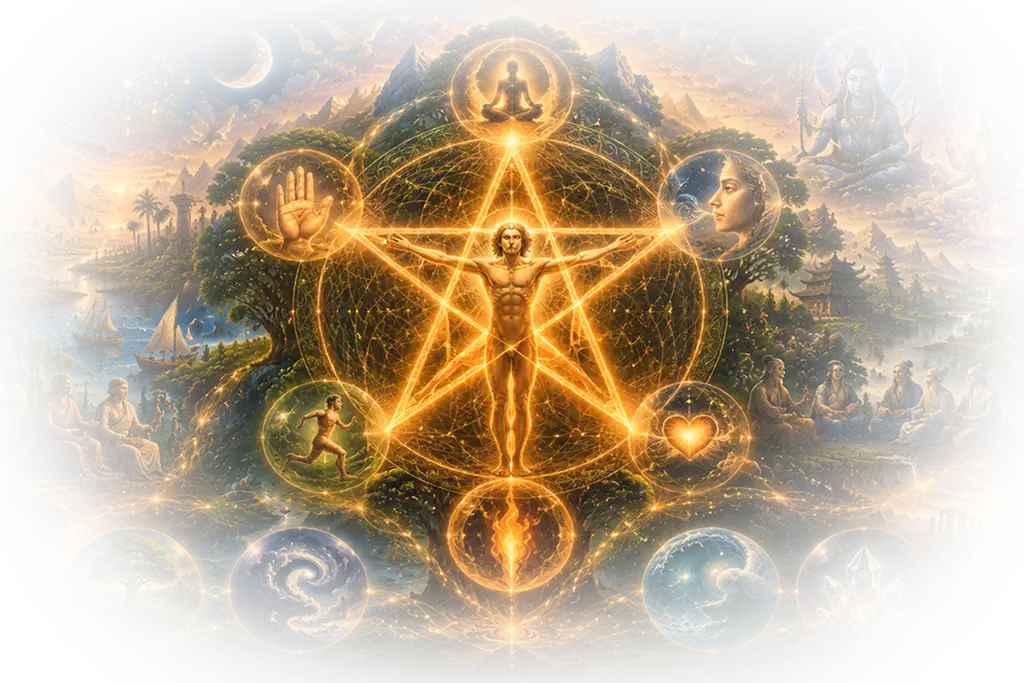
The number of living motion, human consciousness, five senses, the pentagram, and the spirit that animates form.
Essence of the Number Five
Five is the number of life in motion, the human being, and the bridge between heaven and earth. Where Four establishes the stable foundation of the world, Five introduces movement, growth, consciousness, and transformation.
It is the living pulse of creation: the dance within the square, the breath within the body, and the spirit that animates form.
Origins & Early Use ~ The Number Five
Five arises naturally in human observation: five fingers, five toes, five senses, and five extremities of the human body — head, arms, and legs. It therefore became synonymous with the microcosm: the human being as a mirror of the cosmos.
Mathematically, five is 2 + 3: the union of duality and harmony, matter and spirit, feminine and masculine principles. The pentagram, appearing in ancient carvings and later emphasized in Pythagorean schools, became the geometric emblem of this union and of vital energy in motion.
Sacred Writings & Sources by Civilization
Ancient Egypt
Fivefold Soul & Starry Afterlife
In Egyptian symbolism, the five-pointed star was associated with afterlife, divine power, and the imperishable company of the blessed dead. Stars were linked to the “followers of Osiris,” suggesting continuity between life, death, and celestial becoming.
The human soul was often understood through multiple aspects, including Ka, Ba, Ib, Sheut, and Ren.
Study Focus
Concept
Five marks the soul’s wholeness and the living human’s cosmic link.
Mesopotamia
Ishtar, Inanna & Transforming Life Force
The sacred number 5 is associated with Inanna and Ishtar, goddesses of love, war, fertility, descent, and renewal. The five-pointed star appears in Sumerian and Mesopotamian iconography as a sign of divine rulership and expansion.
Study Focus
- Inanna’s Descent to the Underworld
- Royal Inscriptions
Concept
Five is dynamic life-force governing renewal, descent, transformation, and rebirth.
Greece & Rome
The Pentad, Venus & Aether
The Pythagoreans interpreted 5 as the Pentad: the marriage of odd and even numbers, 3 and 2, male and female, harmony and life. The number was linked to health, proportion, and the pentagram.
Five is also associated with Aphrodite and Venus, whose apparent orbital rhythm traces a pentagram-like pattern over eight years. In classical philosophy, Aether appears as a fifth element beyond earth, air, fire, and water.
Study Focus
Celtic Traditions
Five Provinces, Pentacle & Sacred Center
Celtic tradition remembers Ireland through five provinces, each organized around sacred geography and symbolic unity. The pentacle came to represent the five elements — earth, air, fire, water, and spirit — with spirit as the animating center.
Traditions surrounding Brigid sometimes emphasize fires, virtues, and sacred skills that express living motion and transformation.
Study Focus
Norse Traditions
Living Connections Across Realms
Norse tradition does not center five as strongly as three or nine, yet fivefold patterns may be read symbolically through living connections among realms, roots, and beings of the world tree.
Study Focus
Concept
Five becomes the living connection across realms: the movement that animates the cosmological structure.
India & Hinduism
Five Great Elements, Senses & Vital Breaths
Hindu philosophy preserves several sacred fivefold structures, including the Pancha Mahābhūta: Earth, Water, Fire, Air, and Ether; the five senses; and the Pancha Pranas, or five vital breaths.
The Pancha Yajnas link humans to gods, ancestors, nature, beings, and sacred knowledge through daily reciprocal practice.
Study Focus
- Taittiriya Upaniṣad
- Bhagavad Gītā, chapters 7–8
- Vedānta Commentaries
Concept
Five is the rhythm of life and cosmic participation.
Buddhism
Precepts, Aggregates & Wisdoms
Buddhism places five at the foundation of ethical life through the Five Precepts. It also analyzes human experience through the Five Aggregates: form, feeling, perception, formations, and consciousness.
In Mahāyāna and Vajrayāna, the Five Wisdom Buddhas represent transmuted forms of ignorance and awakened cognition.
Study Focus
China, Daoism & Confucianism
Wu Xing: Five Phases of Transformation
Chinese cosmology centers the Wu Xing: Wood, Fire, Earth, Metal, and Water. These are not inert substances but phases, movements, or transformations of Qi.
The Five Phases correspond to seasons, colors, directions, tones, organs, emotions, and patterns of social and cosmic change.
Study Focus
Concept
Life is the balanced interplay of five movements of Qi.
Japan, Shintō & Buddhism
Godai, Gorintō & Five Rings
Japanese esoteric and martial traditions preserve the Godai: Earth, Water, Fire, Wind, and Void. These are embodied architecturally in the Gorintō pagoda.
Miyamoto Musashi structured his strategic teaching through The Book of Five Rings, expressing elemental, martial, aesthetic, and spiritual balance.
Study Focus
Judaism
Torah, Soul Levels & Covenant
Judaism places five at the foundation of sacred teaching through the Five Books of Moses. Kabbalistic tradition also describes five levels of the soul: Nefesh, Ruach, Neshamah, Chayah, and Yechidah.
The five knots in the tzitzit fringes symbolize covenantal remembrance.
Study Focus
Concept
Five is divine order manifest in human life and covenant.
Christianity
Five Wounds, Pentecost & Sanctified Senses
Christianity associates five with the Five Wounds of Christ: hands, feet, and side, symbols of sacrifice and redemption. Pentecost, from the Greek root for fifty, marks the descent of the Holy Spirit and the birth of spiritual life in the Church.
The pentagram appeared in early Christian art as a symbol of the five senses sanctified through Christ’s incarnation.
Scripture
Study Focus
- Thomas Aquinas’ Summa Theologica
- Medieval Christian Symbolism
Islam
Five Pillars, Five Prayers & the Hand of Fāṭimah
Islam places five at the foundation of practice through the Five Pillars: Shahāda, Ṣalāh, Zakāh, Ṣawm, and Ḥajj. The five daily prayers structure the rhythm of worship and return the believer repeatedly to remembrance.
The Hand of Fāṭimah, or Khamsa, uses the five fingers as a sign of divine protection, balance, and blessing.
Study Focus
Concept
Five is the path of submission, balance, embodied discipline, and spiritual vitality.
Africa
Offerings, Movement & Spiral Life-Energy
In Yorùbá ritual symbolism, five can signify vital movement, offering, and change. Some rites may include five offerings to represent living elements or active spiritual forces.
Dogon cosmological interpretations sometimes describe life-energy through spiraling patterns of creation, growth, and transformation.
Study Focus
- Odu Ifá, especially Ogunda and Oyeku
- Dogon Cosmology Studies
Australia & Aboriginal Traditions
Ancestor Paths, Elements & Song
Some Dreaming systems identify primary ancestor beings or paths corresponding to land, water, fire, wind, and song. These patterns emphasize relationship to Country, movement, and sacred memory.
Study Focus
- Central Desert Songline Cycles
- Kimberley Songline Cycles
Definitive Sources for Study of Number 5
Philosophical & Mystical
- The Pythagorean Sourcebook — the Pentad.
Religious
- Taittiriya Upaniṣad — Five Elements.
- Torah — Five Books of Moses.
- Qur’an and Hadith — Five Pillars.
- Buddhist Five Precepts
Comparative Symbolism
- Mircea Eliade, Patterns in Comparative Religion
- C. G. Jung, Man and His Symbols
- René Guénon, Symbolism of the Pentagram
Deity & Symbolic Associations
Ishtar / Inanna: Mesopotamia
Venus / Aphrodite: Greece and Rome
Fivefold Soul Forms: Egypt
Five Elements, Pancha Mahābhūta: Hinduism
Five Wisdom Buddhas: Buddhism
Hand of Fāṭimah / Khamsa: Islam
Five Books of Moses: Judaism
Human Microcosm / Pentagram: Universal
Quotes and Key Statements
“He who knows the five great elements knows the Self.”
Taittiriya Upaniṣad 2.1
“And they were all filled with the Holy Spirit… it was about the third hour of the day.”
Acts 2:4–5
“The five pillars are the foundation of Islam… upon them is built the house of faith.”
Hadith of Gabriel
Cultural References
Literature
- The Book of Five Rings by Miyamoto Musashi — strategy, balance, and elemental mastery.
- Slaughterhouse-Five by Kurt Vonnegut — human existence beyond ordinary time and matter.
- The Fifth Season by N. K. Jemisin — life, apocalypse, and rebirth.
Film
- The Fifth Element — spirit and love as the unifying fifth force.
- Fantastic Five — vitality, group identity, and teamwork.
- Five Easy Pieces — human disconnection and the search for meaning.
Music
- “Take Five” — Dave Brubeck — jazz rhythm in 5/4 time, innovation, and motion.
- “Five to One” — The Doors — rebellion and change.
- Maroon 5 — band identity and balance in popular creativity.
Notes on Usage & Contemplative Practice
Contemplative Exercise
Contemplate your five senses as gateways between inner and outer worlds. Ask how sight, sound, touch, taste, and smell teach you that consciousness is not separate from embodiment.
Ritual Prompt
Trace a pentagram slowly, naming one quality at each point: body, breath, feeling, thought, and spirit. Return to the center and observe the living human as the meeting place of all five.
Result Sought
Vitality, movement, integration, embodied consciousness, transformation, and the awakening of the human microcosm as a bridge between heaven and earth.
Number FIVE
Life, Motion, Transformation, and Humanity
The number of living motion, human consciousness, five senses, the pentagram, and the spirit that animates form.