
CHILDREN OF GOD
500 BCE – 500 CE
A chronological survey of classical, Hellenistic, imperial, and late antique religious transformation, from philosophical religion and Second Temple Judaism to Buddhism, Christianity, Rabbinic Judaism, and classical Hinduism.
Traditions 500 BCE – 500 CE
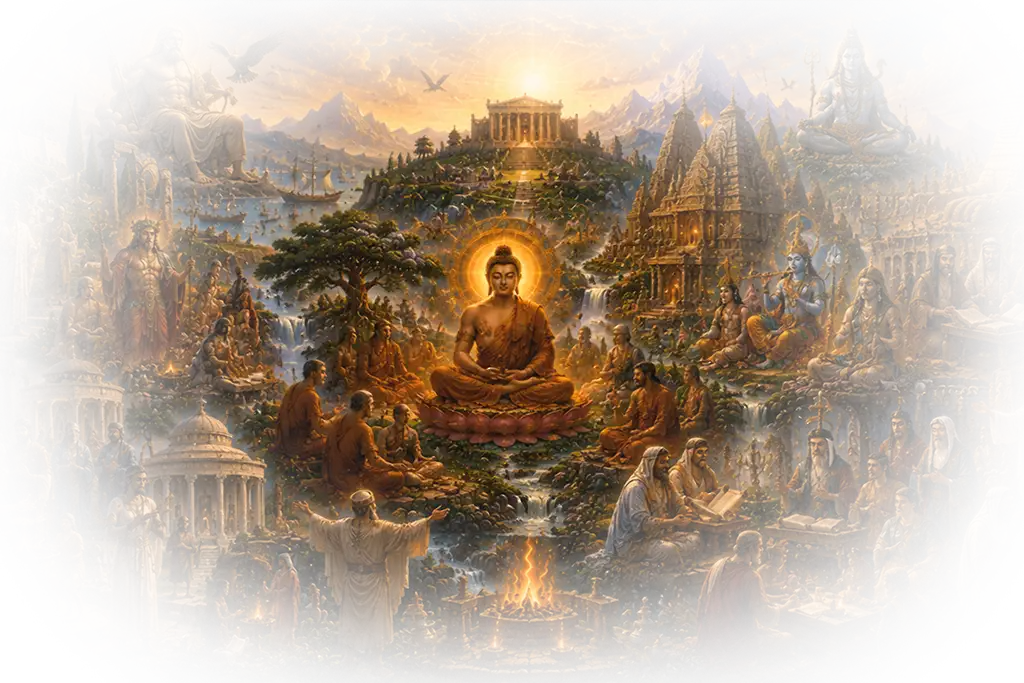
Between 500 BCE and 500 CE, religious history entered an age of expansion, canon formation, philosophical synthesis, and institutional transformation. Traditions that began as local, ethnic, civic, or reform movements increasingly developed into enduring world religions, textual communities, monastic orders, theological schools, and imperial institutions.
This era witnessed the maturation of Buddhism, the transformation of Judaism, the emergence of Christianity, the consolidation of classical Hinduism, and the deepening of philosophical and mystical traditions across the Mediterranean, India, China, Africa, and the Americas.
Chronological Table of Classical and Late Antique Religious Traditions
Rational inquiry, metaphysics, ethics, civic worship
Major Figures / Deities / Concepts:
Historical Importance:
Profound influence on Western philosophy and theology
Greece
Initiatory rites, salvation themes, sacred secrecy
Major Figures / Deities / Concepts:
Historical Importance:
Influenced later Hellenistic spirituality and early Christianity
Mediterranean
Temple worship, scripture, apocalyptic expectation
Major Figures / Deities / Concepts:
Historical Importance:
Context for Rabbinic Judaism and Christianity
Judea
Dharma, karma, bhakti, epics, temple ritual
Major Figures / Deities / Concepts:
Historical Importance:
Formation of classical Hinduism
India
Ethical government, filial piety, social harmony
Major Figures / Deities / Concepts:
Historical Importance:
Became central to Chinese civilization
China
Harmony with the Dao, immortality practices, mysticism
Major Figures / Deities / Concepts:
Historical Importance:
Major Chinese philosophical and religious tradition
China
Virtue ethics, self-control, cosmic order
Major Figures / Deities / Concepts:
Historical Importance:
Influenced Roman ethics and Christian thought
Greece
Bodhisattva ideal, universal salvation, new sutras
Major Figures / Deities / Concepts:
Historical Importance:
Expanded Buddhism across Asia
India & Central Asia
Monastic discipline, Pali canon, nirvana path
Major Figures / Deities / Concepts:
Historical Importance:
Preserved early Buddhist traditions
Sri Lanka & Southeast Asia
Hermeticism & Esoteric Traditions
Mystical knowledge, alchemy, cosmic correspondence
Major Figures / Deities / Concepts:
Historical Importance:
Influenced later occult and mystical traditions
Mediterranean & Egypt
Personal devotion to deities, emotional worship
Major Figures / Deities / Concepts:
Historical Importance:
Reshaped Hindu spirituality
India
Kami worship, purification rites, sacred nature
Major Figures / Deities / Concepts:
Historical Importance:
Foundation of Japanese religion
Japan
Calendrical ritual, astronomy, sacred kingship
Major Figures / Deities / Concepts:
Kukulkan, maize gods
Historical Importance:
Advanced ritual cosmology and sacred mathematics
Mesoamerica
Messianic expectation, cosmic struggle, resurrection
Major Figures / Deities / Concepts:
Historical Importance:
Influenced Christianity and Rabbinic Judaism
Judea
Teachings of Jesus, resurrection faith, apostleship
Major Figures / Deities / Concepts:
Historical Importance:
Origin of Christianity
Roman Empire
Secret knowledge, dualism, spiritual liberation
Major Figures / Deities / Concepts:
Historical Importance:
Major alternative early Christian movement
Roman Empire
Ascetic ethics, karma purification, nonviolence
Major Figures / Deities / Concepts:
Historical Importance:
Enduring Indian religious tradition
India
Initiation, sacred meals, cosmic symbolism
Major Figures / Deities / Concepts:
Historical Importance:
Important Roman mystery religion
Roman Empire & Persia
Torah study, synagogue worship, oral law
Major Figures / Deities / Concepts:
Yohanan ben Zakkai, rabbis
Historical Importance:
Foundation of modern Judaism
Jewish Diaspora
Bishops, creeds, sacraments, canon formation
Major Figures / Deities / Concepts:
Church Fathers, bishops
Historical Importance:
Established orthodox Christianity
Roman Empire
Emanation, mystical ascent, metaphysical unity
Major Figures / Deities / Concepts:
Historical Importance:
Influenced Christian, Jewish, and Islamic philosophy
Mediterranean
Orisha worship, divination, sacred kingship
Major Figures / Deities / Concepts:
Historical Importance:
Major West African religious system
Africa
Cosmic dualism of light and darkness
Major Figures / Deities / Concepts:
Historical Importance:
Spread from Rome to China
Persia
Temple worship, sacred literature, devotional theology
Major Figures / Deities / Concepts:
Historical Importance:
Consolidated classical Hindu civilization
India
State-supported Christianity, ecumenical councils
Major Figures / Deities / Concepts:
Historical Importance:
Christianity became dominant in Europe
Roman Empire
Defined orthodox Christology and creed
Major Figures / Deities / Concepts:
Constantine, bishops
Historical Importance:
Foundational Christian council
Roman Empire
Christianization of Europe, closure of temples
Major Figures / Deities / Concepts:
Roman emperors, bishops
Historical Importance:
Transition from pagan Rome to Christian Europe
Europe
Mythological texts, sectarian devotion
Major Figures / Deities / Concepts:
Historical Importance:
Major form of later Hinduism
India
Translation of sutras, monasteries, syncretism
Major Figures / Deities / Concepts:
Kumarajiva, Chinese monks
Historical Importance:
Established Buddhism in East Asia
China
Major Themes
- Universal religions expanded beyond ethnic, tribal, and civic boundaries.
- Philosophical religion matured in Greece, India, China, and the Near East.
- Buddhism spread throughout South, Central, and East Asia.
- Judaism transformed after the destruction of the Second Temple.
- Christianity emerged from Judaism and became the dominant religion of the Roman Empire.
- Hinduism evolved into devotional, epic, temple-centered, and Puranic forms.
- Mystery religions, esoteric traditions, Gnosticism, Hermeticism, and Neoplatonism flourished across the Mediterranean world.
- Religious texts, canons, creeds, monasteries, councils, and organized institutions became increasingly formalized.
Key Takeaways
Religion became institutional: churches, monasteries, rabbinic schools, councils, temples, and monastic orders gave traditions lasting structures.
Religion became textual: canons, sutras, epics, creeds, oral law, and sacred commentaries became central sources of authority.
Religion became universal: Buddhism and Christianity especially moved across ethnic and imperial boundaries.
Religion became philosophical: Greek, Indian, Chinese, Jewish, Christian, and esoteric traditions developed sophisticated metaphysical systems.
Late Antiquity prepared the medieval world: the religious map of Europe, the Middle East, India, East Asia, and parts of Africa was fundamentally reshaped by 500 CE.
Religious Traditions 500 BCE – 500 CE
Transitional Threshold Toward the Medieval Religious World
Late Antiquity witnessed one of the greatest religious transitions in history.
Pagan empires gave way to universal traditions, scriptural communities, organized churches, monastic networks, rabbinic academies, philosophical schools, and devotional movements.
Christianity rose from persecuted sect to imperial religion.
Rabbinic Judaism emerged after the Temple’s destruction.
Mahayana Buddhism spread internationally.
Hindu devotional religion expanded through bhakti, epic literature, and Puranic mythology.
Neoplatonism, Gnosticism, and Hermeticism deepened the metaphysical and mystical vocabulary of late antique religion.
Buddhist, Christian, Jewish, Hindu, Daoist, and Confucian traditions entered the medieval world with more developed institutions and textual foundations.