
Law VI:
The Law of Cause and Effect
Nothing happens by chance; every cause has its effect, and every effect has its cause.
Essence of the Law
Nothing happens by chance. Every cause has its effect; every effect has its cause. The visible event is the flower of invisible seed, and destiny is shaped by thought, word, deed, intention, omission, and response.
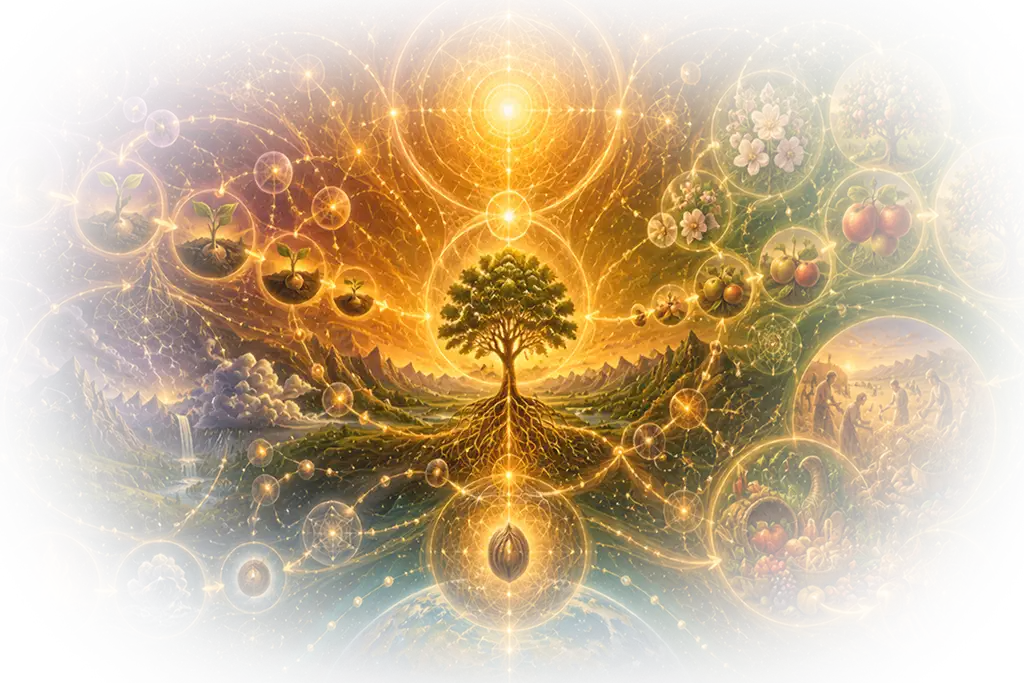
Law Overview
The Law of Cause and Effect teaches that manifestation unfolds through ordered relationship. Events do not arise from emptiness, nor do actions vanish without consequence. Each motion enters the web of becoming and generates further motion according to its nature.
This law is not merely mechanical. In mystical traditions, causality includes moral, spiritual, psychological, and karmic dimensions. A thought may become an attitude; an attitude may become a habit; a habit may become a character; a character may become a destiny.
To practice this law is to awaken from unconscious reaction into deliberate participation. The seeker learns to trace outer circumstances to inner seeds, to act with awareness, and to accept responsibility without despair. Cause and effect become not a prison, but a school of wisdom.
Historical, Civilizational, and Comparative Analysis
Ancient Roots
Hermetic
In The Kybalion, attributed to the Three Initiates, chance is described as law not yet recognized. What appears accidental may be an unseen chain of causes operating beyond ordinary perception.
Indian
In the Bṛhadāraṇyaka Upaniṣad, action and becoming are bound together. The human being is shaped by desire, intention, and deed, and the soul moves according to the subtle consequences it has cultivated.
Greek
Parmenides, in his surviving philosophical fragments, rejects the notion that being can arise from nonbeing. The principle “nothing comes from nothing” becomes a foundational insight into ordered reality.
Pagan Echoes
In modern pagan and Wiccan ethics, the principle of return is often expressed through the idea that energy sent forth comes back to the maker. The Wiccan Rede and related teachings place magical action within a moral field of consequence.
The spell, the word, and the intention are understood as seeds. The practitioner is therefore called to responsibility, discernment, and reverence before acting upon the unseen.
Eastern Echoes
In Buddhist teaching, karma is not arbitrary reward or punishment, but the moral lawfulness of intentional action. The Majjhima Nikāya 135 teaches that beings inherit the results of their karma.
“All beings are owners of their karma.”
Majjhima Nikāya 135
Esoteric Echoes
In Western scientific thought, lawful reaction is famously expressed by Isaac Newton. In the Philosophiæ Naturalis Principia Mathematica, motion is governed by intelligible laws, including action and reaction.
“For every action there is an equal and opposite reaction.”
Isaac Newton, Principia Mathematica
Christian Echoes
Christian scripture expresses moral causality through the image of sowing and reaping. The deed is a seed, the life is a field, and the harvest reveals what has been planted in thought, desire, and action.
“Whatsoever a man soweth, that shall he also reap.”
Galatians 6:7
Notes on Usage, Application, and Practice
Observe Causes
Act with Awareness
Accept Responsibility
See karma not as punishment, but as education. Responsibility is not condemnation; it is the recovery of power to choose a wiser cause.
Quotes and Key Statements
Hermetic: “Chance is but a name for law not recognized.”
Indian: “As a man sows, so shall he reap.”
Bṛhadāraṇyaka Upaniṣad IV.4.5
Greek: “Nothing comes from nothing.”
Parmenides, Fragment 8
Eastern: “All beings are owners of their karma.”
Majjhima Nikāya 135
Christian: “Whatsoever a man soweth, that shall he also reap.”
Representative and Definitive Sources
The Kybalion, Three Initiates — Cause and Effect
Bṛhadāraṇyaka Upaniṣad IV.4.5
Epistle to the Galatians, King James Version
Parmenides, Fragment 8
A pre-Socratic philosophical source for the principle that being cannot arise from nonbeing.
Philosophiæ Naturalis Principia Mathematica, Isaac Newton
A definitive Western scientific source for lawful motion, action, and reaction.
Contemplative Exercise
Choose one recurring circumstance in your life. Without blame, write three possible causes that may have contributed to it: one thought-pattern, one action-pattern, and one neglected truth.
Then write one new cause you can plant today. Let it be small, concrete, and aligned with the harvest you wish to receive.
Literature, Film, Music, and Cultural References
Literature
Macbeth by William Shakespeare
A tragedy of ambition, choice, prophecy, and consequence unfolding from a single corrupted will.
Crime and Punishment by Fyodor Dostoevsky
A psychological and moral exploration of action, guilt, suffering, confession, and redemption.
A Christmas Carol by Charles Dickens
A visionary tale of causes already planted, consequences yet to unfold, and the possibility of moral change.
Film
A cinematic meditation on the seed of an idea and the vast consequences it may generate.
A story of patience, choices, injustice, endurance, and the long harvest of hope.
Music
Johnny Cash, “God’s Gonna Cut You Down”
A stark musical meditation on moral consequence, exposure, and eventual reckoning.
A song of hidden motives, revealed character, and the return of one’s own works.
Law VI:
The Law of Cause and Effect
Every seed becomes a harvest. Every act enters the circle. Sow with wisdom, and the field of life is transformed.