
CHILDREN OF GOD
1000 BCE – 500 BCE
A chronological survey of late ancient and Axial Age religious transformation, when ritual civilizations gave rise to ethical, philosophical, devotional, and liberation-oriented traditions.
Traditions 1000 BCE – 500 BCE
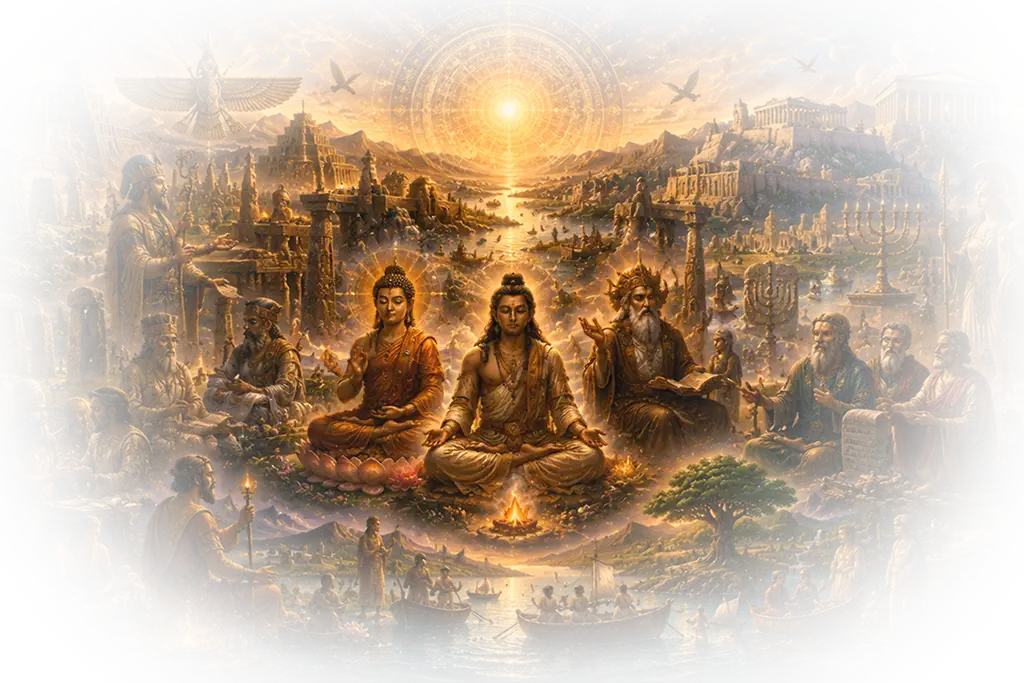
Between 1000 BCE and 500 BCE, the religious imagination of humanity entered one of its most decisive transformations. Ancient temple systems, royal cults, ancestral rites, and sacrificial traditions continued, but they were increasingly joined by prophetic ethics, philosophical inquiry, ascetic discipline, devotional reform, and universal questions of liberation, justice, suffering, and cosmic order.
This period forms the threshold of the Axial Age, when religious traditions across India, China, Persia, Israel, Greece, and the wider ancient world began asking not only how to honor the gods, but how to live rightly, awaken inwardly, govern justly, and understand the hidden structure of reality.
Chronological Table of Axial Age and Late Ancient Religious Traditions
Expansion of sacrificial ritualism, priestly authority, cosmological speculation
Major Figures / Deities / Concepts:
Historical Importance:
Transition from early Vedic religion toward Hindu philosophy
India
Meditation, karma, rebirth, liberation, philosophical inquiry
Major Figures / Deities / Concepts:
Historical Importance:
Foundation of Hindu philosophical spirituality
India
Covenant theology, temple worship, prophetic ethics
Major Figures / Deities / Concepts:
Historical Importance:
Developed into Judaism
Israel & Judah
Maritime temple religion, sacrifice, fertility cults
Major Figures / Deities / Concepts:
Historical Importance:
Spread Near Eastern religion across the Mediterranean
Levant
Olympian gods, oracles, civic ritual, mystery cults
Major Figures / Deities / Concepts:
Historical Importance:
Influenced philosophy, art, and Western civilization
Greece
Ancestor rites, state cults, sacred law, augury
Major Figures / Deities / Concepts:
Historical Importance:
Basis of Roman imperial religion
Italy
Ethical dualism, judgment after death, sacred fire
Major Figures / Deities / Concepts:
Historical Importance:
Influenced Abrahamic eschatology and angelology
Iran
Mandate of Heaven, ancestor veneration, ritual order
Major Figures / Deities / Concepts:
Tian (Heaven), royal ancestors
Historical Importance:
Prepared the ground for Confucianism
China
Harmony with nature, spontaneity, mystical balance
Major Figures / Deities / Concepts:
Historical Importance:
Became a major Chinese religious-philosophical tradition
China
Moral order, filial piety, ethical governance
Major Figures / Deities / Concepts:
Historical Importance:
Shaped East Asian civilization for millennia
China
Druids, sacred groves, warrior cults, nature reverence
Major Figures / Deities / Concepts:
Historical Importance:
Influenced later Celtic spirituality and folklore
Europe
Fate, heroic culture, sacred kingship
Major Figures / Deities / Concepts:
Proto-Odin, Tyr, Thor-like gods
Historical Importance:
Developed into Norse paganism
Northern Europe
Sacred rulership, jaguar symbolism, ceremonial centers
Major Figures / Deities / Concepts:
Jaguar spirits, maize symbolism
Historical Importance:
Foundation for later Mesoamerican religions
Mesoamerica
Renunciation, asceticism, karma, liberation paths
Major Figures / Deities / Concepts:
Wandering ascetics, yogis
Historical Importance:
India
Nonviolence, ascetic discipline, liberation from rebirth
Major Figures / Deities / Concepts:
Historical Importance:
One of India’s major enduring religions
India
Four Noble Truths, Middle Way, liberation from suffering
Major Figures / Deities / Concepts:
Siddhartha Gautama (the Buddha)
Historical Importance:
Became a major world religion
India/Nepal
Monotheism strengthened through exile and scripture
Major Figures / Deities / Concepts:
Historical Importance:
Critical stage in Jewish identity formation
Judah & Babylon
Royal patronage of Zoroastrian and local traditions
Major Figures / Deities / Concepts:
Historical Importance:
Enabled broad religious exchange across Eurasia
Persia
Initiatory salvation rites, sacred secrecy
Major Figures / Deities / Concepts:
Historical Importance:
Influenced later Hellenistic spirituality
Mediterranean
Major Themes
- Ritual religion expanded into philosophical and ethical reflection.
- Sacrificial systems continued while interior spirituality, meditation, and renunciation gained new authority.
- Prophetic traditions strengthened ideas of covenant, justice, moral accountability, and sacred history.
- Karma, rebirth, liberation, and ascetic discipline became central themes in Indian religious thought.
- Chinese traditions emphasized ritual order, ancestral reverence, moral governance, harmony, and the Way.
- Persian religion developed powerful themes of ethical dualism, judgment, cosmic struggle, and sacred fire.
- Greek, Roman, Celtic, Germanic, and Mediterranean traditions preserved civic ritual, hero cults, oracles, mystery rites, and sacred cosmology.
- Religious traditions increasingly moved beyond local tribal identity toward broader philosophical, imperial, and universal frameworks.
Key Takeaways
The sacred became ethical: divine order was increasingly expressed through justice, virtue, covenant, duty, and moral accountability.
The sacred became interior: meditation, renunciation, self-discipline, and inward realization became central paths of religious life.
The sacred became philosophical: traditions began asking systematic questions about self, cosmos, suffering, liberation, reality, and truth.
The sacred became universal: several traditions moved beyond local tribal frameworks toward teachings that could apply to all humanity.
The Axial Age reshaped the future: Hindu philosophy, Buddhism, Jainism, Judaism, Confucianism, Daoism, Zoroastrianism, Greek philosophy, and later Christianity and Islam all stand within this larger transformation.
Religious Traditions Timeline: 1000 BCE – 500 BCE
Transitional Threshold Toward the Axial Age
This era marks the passage from mythic-sacrificial civilization into the age of sages, prophets, philosophers, monks, ascetics, and reformers.
The sacred was no longer encountered only through temple, king, clan, and offering; it was increasingly sought through wisdom, virtue, disciplined practice, moral law, and inward realization.
Upanishadic spirituality deepened the search for Atman, Brahman, and liberation.
Jainism and Buddhism emerged from the renunciant and Śramaṇa world.
Confucianism and Daoism formed enduring Chinese models of ethics, harmony, and sacred order.
Zoroastrianism gave powerful expression to cosmic moral struggle and judgment.
Israelite prophecy and exile traditions strengthened the foundations of later Judaism.
Greek and Mediterranean religions prepared the ground for philosophy, mystery religion, and later Hellenistic spirituality.