
Number TWELVE
Cosmic Order, Divine Governance, and the Sacred Cycles of Time
The number of sacred structure, heavenly order, cyclical time, divine authority, and wholeness made manifest.
Essence of the Number Twelve
Twelve is the number of cosmic structure, harmony, and divine governance: the perfected order of heaven expressed in the patterns of the world. Where Eleven broke through the limits of form into revelation, Twelve establishes the new sacred order that revelation reveals.
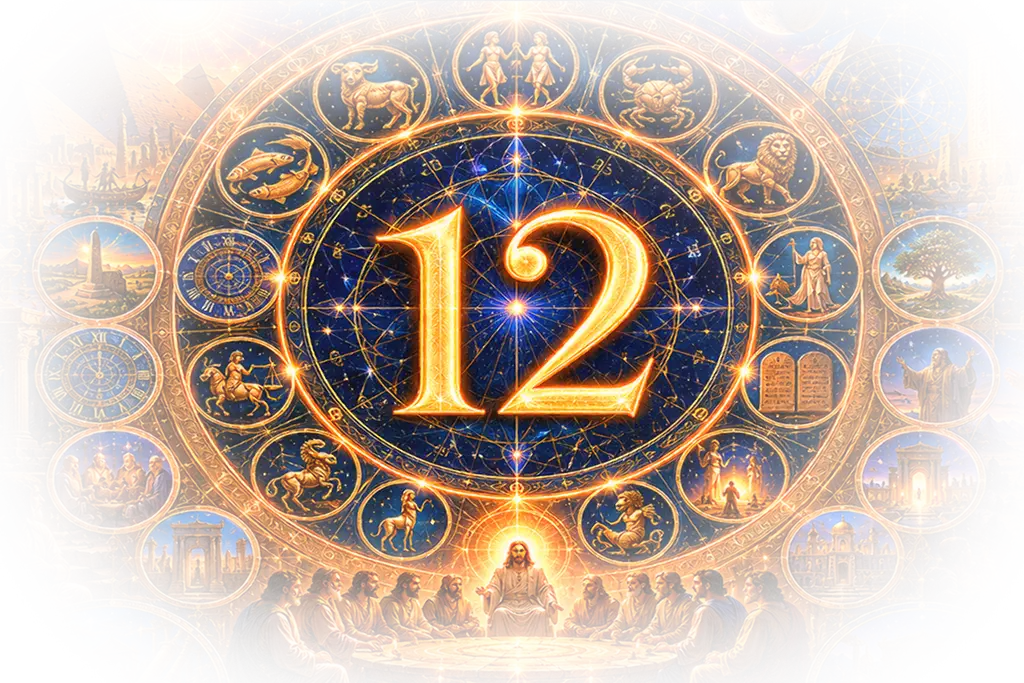
It is the number of organization, authority, completion within time, and wholeness made manifest: twelve months, twelve constellations, twelve hours, twelve tribes, twelve disciples, and twelvefold structures of sacred rule.
Origins & Early Use ~ The Number Twelve
Ancient astronomers divided the heavens into twelve constellations of the zodiac, giving rise to the twelve-month calendar: a celestial pattern governing both cosmos and civilization.
Twelve became a nearly universal sacred number: symbol of the ordered cosmos, divine rulership, and cyclical perfection. Mathematically, twelve is highly composite, divisible by 2, 3, 4, and 6, making it ideal for measures of time, music, geometry, governance, and ritual order.
Sacred Writings & Sources by Civilization
Ancient Egypt
Twelve Hours of the Duat
Egyptian cosmology divides the night journey of the sun through the Duat into twelve hours, each guarded by powers and mysteries that mark the solar passage toward rebirth.
Twelve forms or stages of Ra illuminate this underworld journey, revealing the measured rhythm of light’s victory over darkness.
Study Focus
- Book of Amduat
- Book of Gates
- Book of the Twelve Hours of Night
Concept
Twelve is the measured rhythm of light’s victory over darkness.
Mesopotamia
The Zodiac and the Architecture of Heaven
Babylonian astronomers organized the heavens through a twelve-sign zodiac that structured the celestial year. Twelve major gods of the pantheon, with Anu presiding as king, mirror the divine architecture of heaven and empire.
Study Focus
- Enuma Elish
- Astronomical Tablets
- Babylonian Zodiac Records
Concept
Twelve is the divine architecture of heaven and empire.
Greece & Rome
The Twelve Olympians and Heroic Completion
The Twelve Olympians embody a complete divine council, each god or goddess ruling an aspect of cosmos, civilization, and human life.
The Twelve Labors of Heracles represent initiation through a full cycle of trials, while Plato reflects on cosmic harmony, soul, and celestial order.
Study Focus
Concept
Twelve is governance through divine order: the completion of heroic and cosmic evolution.
Celtic Traditions
The Year’s Full Circle
Celtic and Druidic seasonal interpretations sometimes frame ritual time through twelve great feasts or solar-lunar observances, joining the visible year with sacred recurrence.
Cairns, temples, and ritual landscapes may be oriented to solar risings, seasonal stations, and celestial cycles that express the balance of time and eternity.
Study Focus
- Druidic Calendar Studies
- Lebor Gabála Érenn
- Ogham Correspondences
Concept
Twelve is balance between time and eternity in the cycle of life.
Norse Traditions
The Divine Council of Asgard
The Æsir of Asgard are sometimes listed in twelvefold divine order under Odin’s rule, especially in later summaries such as Gylfaginning.
Valhalla’s gates and divine halls symbolize completeness of glory, judgment, and celestial order mirrored in heroic society.
Study Focus
Concept
Twelve is the order of the divine council: celestial rule mirrored on earth.
India & Hinduism
Adityas, Jyotirlingas & the Heart Lotus
Hindu tradition honors the Twelve Adityas, solar forms associated with months and principles of dharma. The Twelve Jyotirlingas mark a sacred geography of Shiva devotion across India.
The twelve-petaled lotus of the heart chakra, Anāhata, symbolizes harmony, devotion, and unconditional love.
Study Focus
Concept
Twelve is divine rhythm manifest in creation and devotion.
Buddhism
Twelve Nidanas and the Cycle of Awakening
Buddhism teaches the Twelve Nidānas, or links of dependent origination, describing the chain of cause and effect that binds beings to samsara.
The Twelve Deeds of the Buddha form an archetypal pattern of enlightenment, showing how awakening unfolds through life, teaching, and liberation.
Study Focus
- Abhidharma
- Lalitavistara Sutra
- Twelve Nidānas Commentary
Concept
Twelve is understanding of the cycle: freedom through awareness.
China, Daoism & Confucianism
Earthly Branches, Meridians & Cosmic Correspondence
The Twelve Earthly Branches correspond to zodiac animals, time cycles, directions, and calendar order. The twelve lunar months and twelve meridians in Chinese medicine express harmony between nature, body, and cosmic rhythm.
Study Focus
Concept
Twelve is cosmic correspondence: the unity of heaven, earth, and humanity.
Japan, Shintō & Buddhism
Twelve Guardians and Divine Protection
Japanese Buddhist tradition recognizes the Jūni Shinshō, twelve guardian deities who protect the Buddha’s teachings. They form a protective circle of sacred authority and disciplined power.
Imperial and ritual traditions also preserve twelvefold virtues of divine rule, order, and right governance.
Study Focus
- Kojiki
- Nihon Shoki
- Shinshō Sutras
Judaism
Twelve Tribes, Gemstones & Covenant Order
The Twelve Tribes of Israel, descended from Jacob’s sons, form the foundation of Israel’s sacred nationhood. The High Priest’s breastplate held twelve gemstones, one for each tribe, and twelve loaves of showbread symbolized continual covenant.
Study Focus
Concept
Twelve is divine government through chosen order.
Christianity
Twelve Apostles and the New Jerusalem
The Twelve Apostles represent the universal mission of Christ and mirror the twelve tribes of Israel. In Revelation, the New Jerusalem has twelve gates and twelve foundations, symbolizing entry into divine perfection.
Jesus first appears in the temple at age twelve, awakening divine wisdom within sacred order.
Scripture
Study Focus
Concept
Twelve is divine order completed in Christ: governance of the heavenly kingdom.
Islam
Twelve Imams and the Sacred Calendar
In Shia Islam, the Twelve Imams represent a chain of divine guidance after the Prophet. The twelve lunar months of the Islamic calendar structure sacred worship, pilgrimage, fasting, and remembrance.
Mystically, twelve may symbolize completion of the prophetic cycle and cosmic justice.
Study Focus
Concept
Twelve is structure of divine guidance and time’s completion.
Africa
Cosmic Egg, Elders of Creation & Divine Council
Dogon cosmological interpretations sometimes describe twelve signs or structures of the cosmic egg completing the order of the universe. Yorùbá symbolism may speak of elders of creation presiding under Olódùmarè, expressing communal order and divine formation.
Study Focus
Concept
Twelve is divine council and sacred order of life.
Australia & Aboriginal Traditions
Totemic Community and Cosmic Wholeness
In some Dreaming systems, twelve primary totems or ancestor beings may be interpreted as forming a complete sacred community and cosmological structure, linking land, kinship, ceremony, and ancestral presence.
Study Focus
- Arnhem Land Oral Traditions
- Kimberley Oral Traditions
Concept
Twelve is sacred community and cosmic wholeness.
Definitive Sources for Study of Number Twelve
Philosophical & Mystical
- The Pythagorean Sourcebook — Dodecad.
- Plato’s Timaeus — celestial spheres.
- Zohar — twelve tribes and gemstones.
Religious
- Genesis 49
- Exodus 28
- Revelation 21
- Qur’an 9:36
- Lalitavistara Sutra — Twelve Deeds.
Comparative Symbolism
- Mircea Eliade, Patterns in Comparative Religion
- René Guénon, Symbols of Sacred Science
- Joseph Campbell, The Hero with a Thousand Faces
Deity & Symbolic Associations
Twelve Olympians: Greece
Twelve Adityas and Jyotirlingas: Hinduism
Twelve Tribes of Israel: Judaism
Twelve Apostles: Christianity
Twelve Imams: Islam
Twelve Hours of the Duat: Egypt
Twelve Earthly Branches: China
Twelve Æsir: Norse
Twelve Elders of Creation: Yorùbá
Twelve Guardians: Japan
Three Quotes on “12”
“And he called unto him his twelve disciples, and gave them power…”
Matthew 10:1
“He set the twelve constellations in order, each to rule its appointed time.”
Babylonian Star Tablet
“Twelve are the deeds of the Tathāgata, each a step toward enlightenment for all beings.”
Lalitavistara Sutra
Cultural References
Literature
- The Twelve Caesars by Suetonius — authority and human imperfection.
- The Twelve Dancing Princesses by the Brothers Grimm — cycles of beauty, mystery, and transgression.
- Paradise Lost by John Milton — twelve books structuring cosmic order.
Film
- 12 Angry Men — human judgment and moral order.
- Twelve Monkeys — cyclical time and transformation.
- Ocean’s Twelve — collective action and balance of forces.
Music
- Twelve Variations — Mozart, Beethoven, and others — harmony and symmetry.
- 12-Bar Blues — foundational musical cycle of tension and resolution.
- “Twelve Days of Christmas” — ascending gifts of joy and abundance.
Notes on Usage & Contemplative Practice
Contemplative Exercise
Reflect on the twelvefold structure of your year, your obligations, your communities, and your inner governance. Ask what order is already present and what sacred structure must be restored.
Ritual Prompt
Draw a circle and divide it into twelve parts. Name each part as a month, a virtue, a responsibility, or a house of life. Stand at the center and contemplate how multiplicity remains whole.
Result Sought
Sacred organization, responsibility, harmony in time, wise governance, communal order, and recognition of cosmic pattern in daily life.
Number TWELVE
Cosmic Order, Divine Governance, and the Sacred Cycles of Time
The number of sacred structure, heavenly order, cyclical time, divine authority, and wholeness made manifest.