
CHILDREN OF GOD
Before 1000 BCE
A chronological survey of humanity’s earliest sacred systems, from prehistoric animism to the threshold of the Axial Age.
Traditions Before 1000 BCE
Before 1000 BCE, religion emerged as humanity’s primal language of meaning: a sacred grammar of land, sky, ancestor, animal, temple, offering, and cosmic order. These traditions shaped the earliest foundations of myth, ritual, priesthood, divine kingship, afterlife belief, sacred law, and philosophical speculation.
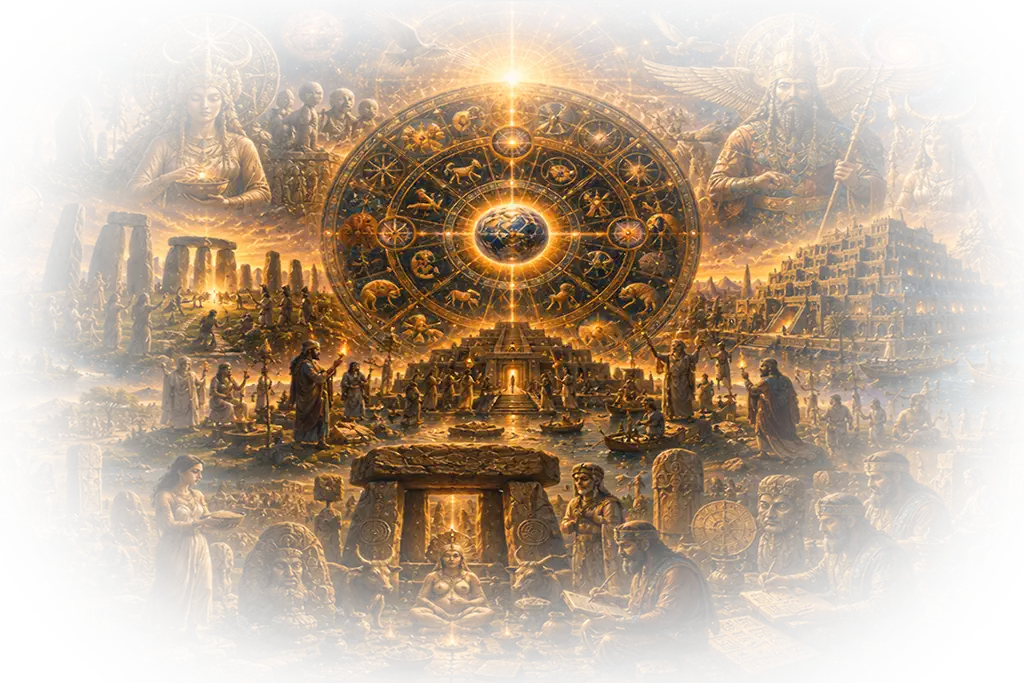
Chronological Table of Early Religious Traditions
Spirit-filled cosmos, ritual healing, trance states, sacred animals, ancestor reverence
Major Deities / Sacred Concepts:
Animal spirits, ancestors, nature powers, dream realms
Lasting Influence:
Foundation of nearly all later religious symbolism and ritual structures
Global Prehistoric Societies
Cave sanctuaries, fertility imagery, ritual burials, celestial observation
Major Deities / Sacred Concepts:
Mother figures, hunting spirits, cosmic cycles
Lasting Influence:
Early sacred art and ceremonial religion
Europe & Eurasia
Seasonal rites, fertility cults, sacred agriculture, megalithic ritual centers
Major Deities / Sacred Concepts:
Earth Mother, Sky Father, solar and lunar powers
Lasting Influence:
Established temple ritual, sacred kingship, and agricultural cosmology
Fertile Crescent & Global Neolithic Cultures
Household shrines, bull symbolism, goddess imagery
Major Deities / Sacred Concepts:
Mother goddess figures, bulls, ancestors
Lasting Influence:
Early urban ritual and symbolic architecture
Anatolia
Stone circles, astronomical alignments, burial mounds
Major Deities / Sacred Concepts:
Solar and lunar powers, ancestral spirits
Lasting Influence:
Influenced later European sacred landscapes
Europe
Temple cities, divine kingship, cosmic order, priesthoods
Major Deities / Sacred Concepts:
Lasting Influence:
Influenced Babylonian, Assyrian, and later Abrahamic symbolism
Mesopotamia
Divine pharaohs, afterlife theology, cosmic balance
Major Deities / Sacred Concepts:
Lasting Influence:
Influenced Mediterranean mysticism and afterlife concepts
Egypt
Ritual bathing, proto-yogic symbolism, sacred animals
Major Deities / Sacred Concepts:
Proto-Shiva imagery, fertility symbols
Lasting Influence:
Possible roots of later Hindu symbolism
Indus Valley
Fire rituals, cosmic dualism, sacred hymns
Major Deities / Sacred Concepts:
Sky gods, fire deities, asha/order
Lasting Influence:
Gave rise to Vedic and Iranian religious systems
Iran & Central Asia
Sacrificial fire rituals, priestly hymns, cosmic law
Major Deities / Sacred Concepts:
Lasting Influence:
Foundation of Hinduism
India
Temple sacrifice, fertility worship, storm gods
Major Deities / Sacred Concepts:
Lasting Influence:
Influenced early Israelite religion
Levant
Cosmic kingship, astrology, sacred law
Major Deities / Sacred Concepts:
Lasting Influence:
Influenced astrology, apocalyptic thought, and mythic cosmology
Mesopotamia
Warrior rites, sacred groves, sky gods
Major Deities / Sacred Concepts:
Proto-Odin, thunder gods, fate powers
Lasting Influence:
Basis for later Norse and Germanic religions
Northern Europe
Palace cults, hero worship, oracle traditions
Major Deities / Sacred Concepts:
Lasting Influence:
Shaped Classical Greek religion and philosophy
Greece
Ancestor veneration, oracle bones, heavenly mandate
Major Deities / Sacred Concepts:
Shangdi, ancestral spirits
Lasting Influence:
Basis for Chinese ancestral religion and later Confucian cosmology
China
Ancestor reverence, spirit mediation, sacred kingship
Major Deities / Sacred Concepts:
Proto-Orishas, creator spirits
Lasting Influence:
Influenced later African and Afro-diasporic religions
Africa
Covenant theology, tribal worship, sacred law
Major Deities / Sacred Concepts:
Yahweh, covenant traditions
Lasting Influence:
Developed into Judaism
Levant
Treaty oaths, storm-god worship, syncretic pantheons
Major Deities / Sacred Concepts:
Tarhunt, sun goddesses
Lasting Influence:
Influenced Near Eastern state religion
Anatolia
Ethical dualism, cosmic struggle, sacred fire
Major Deities / Sacred Concepts:
Lasting Influence:
Influenced Judaism, Christianity, and Islam
Persia
Sacred groves, druids, river worship, warrior rites
Major Deities / Sacred Concepts:
Horned gods, solar deities, ancestral spirits
Lasting Influence:
Influenced later Celtic spirituality
Europe
Heaven’s mandate, ritual order, ancestor rites
Major Deities / Sacred Concepts:
Tian (Heaven), ancestral spirits
Lasting Influence:
Foundation of Confucian ritual thought
China
Tribal sanctuaries, sacred stones, pilgrimage rites
Major Deities / Sacred Concepts:
Lunar deities, tribal gods
Lasting Influence:
Influenced pre-Islamic Arabian religion
Arabian Peninsula
Earth-centered cosmology, shamanic rites, sacred animals
Major Deities / Sacred Concepts:
Sky beings, maize spirits, earth powers
Lasting Influence:
Influenced later Mesoamerican and Andean religions
Americas
Dreamtime cosmology, songlines, ancestral creation myths
Major Deities / Sacred Concepts:
Ancestral beings, land spirits
Lasting Influence:
One of humanity’s oldest continuous spiritual traditions
Oceania
Major Themes
- Nature was widely understood as sacred and alive with spiritual presence.
- Ancestor reverence formed a core religious pattern across civilizations.
- Sacred kingship linked political authority with divine legitimacy.
- Ritual sacrifice, offerings, and priesthoods emerged in most agricultural societies.
- Solar, lunar, storm, fertility, and underworld symbolism became universal motifs.
- Temples, sacred mountains, rivers, and celestial alignments served as centers of worship.
- Mythology preserved cosmology, ethics, creation narratives, and social order.
- Early religious systems established the foundations for later Hindu, Jewish, Buddhist, Christian, Islamic, Daoist, and Indigenous traditions.
Key Takeaways
Religion began as relationship: between humans, ancestors, animals, land, sky, and unseen powers.
Ritual created order: sacrifice, burial, pilgrimage, and seasonal ceremony aligned human life with cosmic rhythm.
Myth preserved memory: early stories encoded creation, kingship, morality, death, and divine presence.
Institutions emerged gradually: temples, priesthoods, sacred texts, and royal cults transformed local rites into civilizations.
The Axial Age was prepared by deep antiquity: later philosophy and world religion grew from these ancient symbolic roots.
Religious Traditions Before 1000 BCE
Transitional Threshold Toward the Axial Age
Religion began as relationship: between humans, ancestors, animals, land, sky, and unseen powers.
Ritual created order: sacrifice, burial, pilgrimage, and seasonal ceremony aligned human life with cosmic rhythm.
Myth preserved memory: early stories encoded creation, kingship, morality, death, and divine presence.
Institutions emerged gradually: temples, priesthoods, sacred texts, and royal cults transformed local rites into civilizations.
The Axial Age was prepared by deep antiquity: later philosophy and world religion grew from these ancient symbolic roots.