
Law XVII:
The Law of Creation
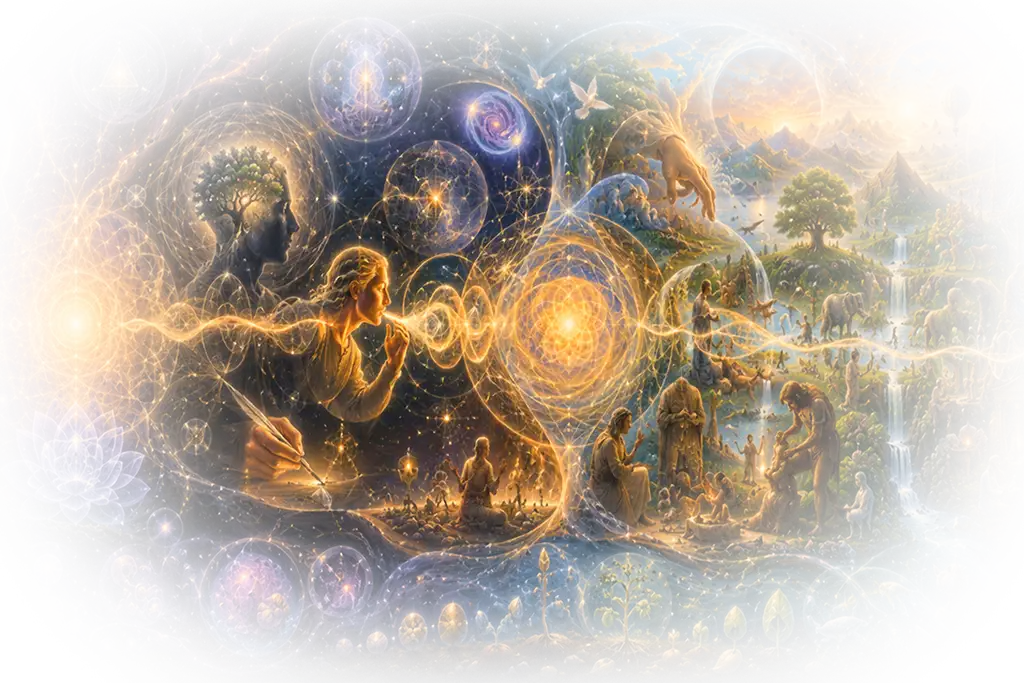
Creation is the perpetual act of consciousness expressing itself.
Essence of the Law
Creation is the perpetual act of consciousness expressing itself. Thought, word, and deed form the trinity of manifestation, and every created thing begins as an inward image seeking outward form.
Law Overview
The Law of Creation teaches that reality is continually being formed through consciousness. The universe is not merely a finished object, but an ongoing utterance: conceived in mind, spoken through power, and embodied through action.
In sacred traditions, creation appears through heart, tongue, desire, word, sound, mind, light, and divine command. These images reveal a common pattern: what is inwardly conceived becomes outwardly ordered through expression.
To practice this law is to create consciously. The seeker learns to form clear images, speak with precision and reverence, and complete thought and speech through faithful deed.
Historical, Civilizational, and Comparative Analysis
Ancient Roots
Egyptian
In the Memphite Theology, preserved through the Shabaka Stone, Ptah conceives the world in his heart and speaks it with his tongue. Creation arises through the union of inner conception and spoken power.
Vedic
In the Nāsadīya Sūkta of the Rig Veda, desire appears as the first seed of mind. Before form fully emerges, longing, awareness, and subtle impulse stir within the mystery of the One.
Hermetic
In the Corpus Hermeticum, Mind gives birth to a being like unto itself. Creation is the expression of divine Mind, Life, and Light, unfolding through likeness and emanation.
Pagan Echoes
In ceremonial and grimoire traditions, the spoken spell shapes the unseen into form. The Key of Solomon and related magical texts preserve ritual speech, seals, names, and gestures as instruments of directed creation.
The creative act is not merely saying words, but uniting intention, symbol, timing, and force until the invisible pattern is given a vessel.
Eastern Echoes
The Dhammapada opens with the primacy of mind. Thought does not merely accompany the world; it conditions the world one experiences and participates in making.
“With thought we make the world.”
Dhammapada 1:1
Esoteric Echoes
Hildegard of Bingen, in Scivias, presents creation through vision, word, and divine illumination. The Word becomes seed, and every work bears the imprint of spiritual origin.
“The Word is the seed of every work.”
Hildegard of Bingen, Scivias II.1
Christian Echoes
In Genesis, creation begins through divine speech. Light appears because God speaks, revealing the creative power of Word as command, illumination, and ordering principle.
“And God said, Let there be light: and there was light.”
Genesis 1:3
Notes on Usage, Application, and Practice
Conceive Clearly
Speak Powerfully
Act Faithfully
Complete thought and speech through deed. What remains only imagined is seed; what is spoken and embodied becomes creation.
Quotes and Key Statements
Egyptian: “Ptah conceived the world in his heart and spoke it with his tongue.”
Vedic: “By desire the One arose; that was the first seed of mind.”
Rig Veda X.129.4, Nāsadīya Sūkta
Hermetic: “Mind, the Father, who is Life and Light, gave birth to a Man like unto Himself.”
Corpus Hermeticum I.12
Western: “The Word is the seed of every work.”
Hildegard of Bingen, Scivias II.1
Christian: “And God said, Let there be light.”
Representative and Definitive Sources
Rig Veda X.129, Nāsadīya Sūkta
Book of Genesis, King James Version
A Hermetic source for divine Mind, Life, Light, emanation, and creation through spiritual likeness.
A Christian visionary source for divine word, image, illumination, and creative revelation.
Contemplative Exercise
Choose one thing you wish to create: a habit, work, relationship, ritual, garden, sentence, song, or act of healing. Write it first as an image, then as a spoken vow, then as one concrete deed.
Ask: Is the image clear? Are the words true? Is the action faithful? Align all three before beginning.
Literature, Film, Music, and Cultural References
Literature
The Silmarillion by J. R. R. Tolkien
A mythic creation story in which the world is sung into being through the Music of the Ainur.
An epic meditation on creation, divine command, free will, fall, and cosmic order.
A cautionary tale of human creation, responsibility, abandonment, and the moral cost of power without wisdom.
Film
A meditation on maker and made, artificial life, memory, mortality, and the responsibilities of creation.
A modern technological parable of creation, consciousness, control, and unintended consequence.
Music
A song invoking word, love, and shared proclamation as creative cultural force.
A contemplative song of brokenness, light, and the imperfect opening through which renewal enters.
Law XVII:
The Law of Creation
Conceive in truth. Speak with power. Act in faith. Through thought, word, and deed, the unseen becomes form.