
Law V:
The Law of Rhythm
Everything flows out and in; all things rise and fall.
Essence of the Law
Everything flows out and in; all things rise and fall. Rhythm compensates—what swings forward must return, and every movement of life belongs to a greater cycle of departure, return, rest, and renewal.
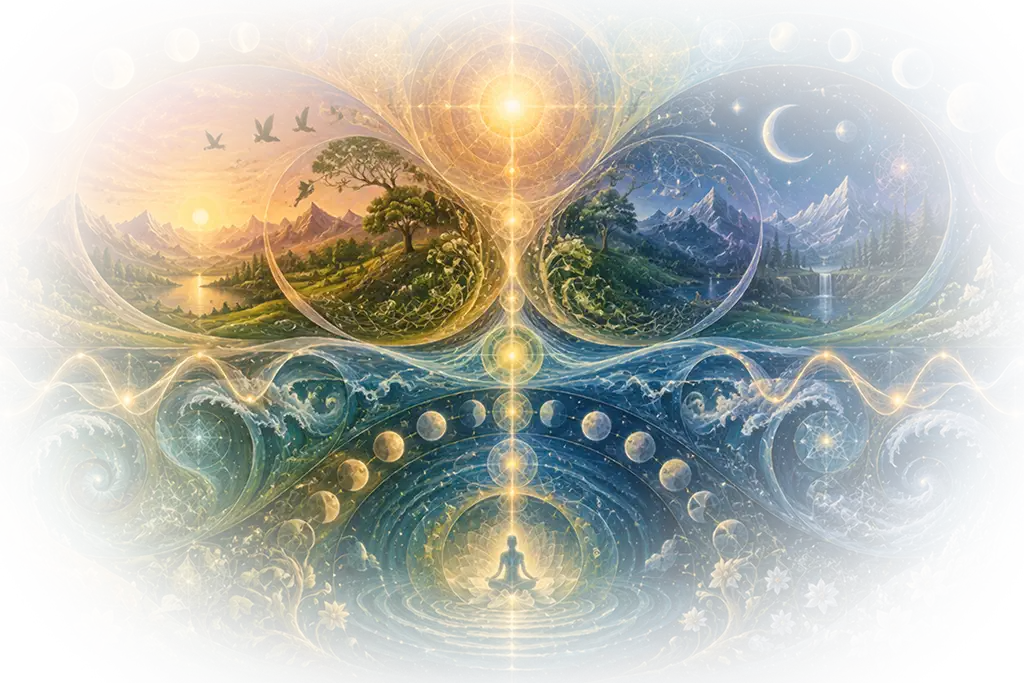
Law Overview
The Law of Rhythm teaches that creation moves by pulse, tide, breath, season, orbit, and recurrence. Nothing in manifestation remains fixed in one state forever. Growth and decline, fullness and emptiness, day and night, birth and death all participate in the same sacred motion.
To understand rhythm is to cease mistaking one phase for the whole. The waning moon is not failure; winter is not abandonment; silence is not absence. Each descent prepares ascent, and each ending gathers the hidden force of a beginning.
The practitioner of this law learns timing, patience, and trust. Rather than resisting the swing of the pendulum, the seeker studies it, enters its wisdom, and finds the still center around which all motion turns.
Historical, Civilizational, and Comparative Analysis
Ancient Roots
Egyptian
In ancient Egypt, the rise and fall of the Nile was more than a natural event; it was the heartbeat of civilization. Flood, fertility, planting, and harvest taught that life depends upon rhythm, and that divine order is revealed through recurring waters.
Hermetic
In The Kybalion, attributed to the Three Initiates, rhythm is described as the universal pendulum-swing. All things flow out and in, rise and fall, advance and retreat, expressing the compensating movement of the manifested world.
Vedic
The Rig Veda praises the dawns that return again and again, shining with renewed light. In Vedic imagination, recurrence is not monotony but sacred reappearance, the world’s continual restoration through cosmic order.
Pagan Echoes
Pagan traditions often honor rhythm through the Wheel of the Year, where solstices, equinoxes, seedtime, harvest, death, and rebirth form a liturgical circle. The sacred is encountered not outside time, but through time’s recurring gates.
The Celtic Book of Invasions preserves mythic cycles of arrival, struggle, sovereignty, and transformation, reflecting a worldview in which peoples, gods, and lands move through patterned epochs.
Eastern Echoes
The Tao Te Ching, attributed to Lao Tzu, teaches return as the motion of the Tao. The moon waxes and wanes yet is never lost; life moves through alternation while the hidden source remains whole.
“The moon waxes and wanes, yet is never lost.”
Tao Te Ching 16, Lao Tzu
Esoteric Echoes
Christian Echoes
Christian scripture gives one of the clearest expressions of sacred rhythm in the language of appointed seasons. Life is not one undifferentiated demand, but a sequence of times for planting, mourning, healing, building, silence, speech, and peace.
“To every thing there is a season, and a time to every purpose under the heaven.”
Ecclesiastes 3:1
Notes on Usage, Application, and Practice
Observe Cycles
Honor Both Ascent and Decline
Find Stillness in Movement
Meditate upon the eternal balance within the flux. The pendulum swings, but the point from which it hangs remains still.
Quotes and Key Statements
Egyptian: “The Nile rises and falls; life depends upon its rhythm.”
Temple Hymns of Heliopolis
Hermetic: “Everything flows, out and in; the pendulum-swing manifests in everything.”
Vedic: “The dawns return again and again, shining with the same light.”
Rig Veda I.113
Western: “Time turns, the year runs on.”
Christian: “To every thing there is a season.”
Representative and Definitive Sources
Rig Veda I.113
Ecclesiastes, King James Version
Tao Te Ching 16, Lao Tzu
A Roman poetic and ritual calendar exploring sacred time, myth, and the turning year.
Contemplative Exercise
Track one rhythm for seven days: your breath, dreams, energy, emotions, appetite, creativity, or prayer. Record when it rises, when it falls, and what conditions shape its movement.
At the end of the seventh day, ask: What phase am I in? What am I trying to force that should be allowed to rest? What is returning that I am now ready to receive?
Literature, Film, Music, and Cultural References
Literature
A contemplative poetic cycle on time, stillness, recurrence, and spiritual return.
A modernist meditation on cultural barrenness, seasonal renewal, and broken sacred cycles.
The Golden Bough by James George Frazer
A comparative study of ritual cycles, dying-and-rising gods, kingship, fertility, and seasonal myth.
Film
A comic and spiritual parable of recurrence, repetition, moral awakening, and eventual transformation.
A cinematic spiral of time, return, memory, inevitability, and the difficulty of escaping a cycle.
Music
The Byrds, “Turn! Turn! Turn!”
A musical setting of Ecclesiastes that directly expresses the sacred rhythm of appointed seasons.
A song of binding cycles, return, tension, and relational recurrence.
Law V:
The Law of Rhythm
The tide withdraws and returns. The moon empties and fills. In every rhythm, the hidden center remains.