
Law III:
The Law of Vibration
Nothing rests; everything moves and vibrates.
Essence of the Law
Nothing rests; everything moves and vibrates. Existence itself is motion within consciousness, and all forms are tones, rhythms, and frequencies temporarily gathered into visible shape.
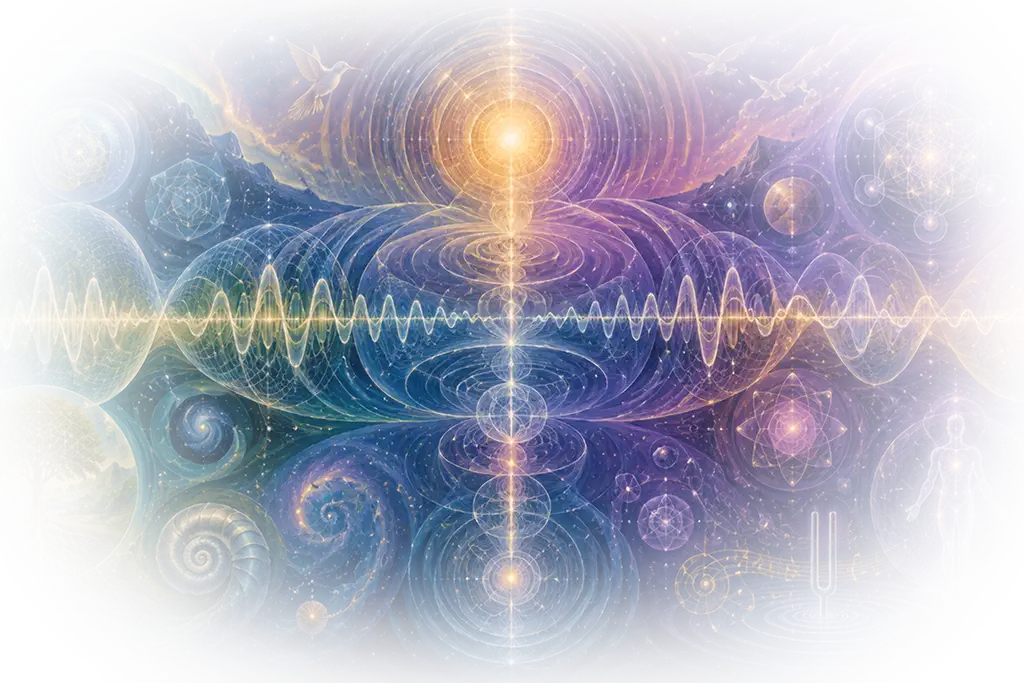
Law Overview
The Law of Vibration teaches that stillness is never absence, but the hidden depth of motion. Beneath all visible forms, life pulses, speaks, sings, turns, breathes, and trembles with subtle force.
In sacred traditions, vibration appears as sound, word, chant, breath, mantra, number, music, speech, harmony, and divine utterance. The universe is not only made; it is voiced. Every created thing carries a signature tone by which it participates in the whole.
To practice this law is to become attentive to the quality of one’s own vibration. Thought, speech, emotion, prayer, music, and intention each alter the field of manifestation. What is spoken with clarity becomes formative; what is sung with devotion becomes a bridge; what is held in the heart becomes a frequency that calls its likeness.
Historical, Civilizational, and Comparative Analysis
Ancient Roots
Egyptian
In Egyptian theology, creation is frequently understood through the power of sacred speech. In the Memphite Theology, associated with the Shabaka Stone, Ptah conceives creation in the heart and brings it forth by the tongue. Thought becomes word, and word becomes world.
Vedic
In Vedic tradition, sound is not merely symbolic; it is ontological. The sacred principle of Śabda points toward sound as a subtle foundation of reality, while the hymns of the Rig Veda preserve the sense that divine utterance, praise, and vibration participate in creation itself.
Greek and Pythagorean
For the Pythagoreans, number and harmony revealed the deep order of the cosmos. Iamblichus, writing on Pythagoras, preserves the doctrine that the universe is structured through harmony and number. Music, mathematics, and metaphysics become different ways of hearing one order.
Pagan Echoes
In pagan and shamanic traditions, rhythm opens the threshold between worlds. The drumbeat calling spirits mirrors life’s pulse in all realms, and chant becomes a vehicle by which the practitioner enters altered states of perception.
Baltic runic songs and other oral traditions preserve the understanding that sound carries memory, magic, lineage, and sacred force. The sung word is not ornament; it is an act of participation in the living cosmos.
Eastern Echoes
The Māṇḍūkya Upaniṣad identifies Om as the imperishable word and the totality of experience. Waking, dreaming, deep sleep, and the transcendent fourth state are contemplated through sound.
“Om, the imperishable word, is all this.”
Māṇḍūkya Upaniṣad 1
Esoteric Echoes
In the Western poetic and mystical imagination, the movement of heaven is often described as harmony. Dante Alighieri, in the Paradiso, presents the cosmos as moved by divine love and celestial order. The stars do not merely shine; they participate in a grand spiritual music.
“The harmony of heaven moves the sun and the other stars.”
Paradiso, Dante Alighieri
Christian Echoes
Christian theology often speaks of creation as held together by the divine Word. In the Epistle to the Colossians, the created order subsists through Christ, expressing the idea that all things cohere through a living spiritual principle.
“By Him all things consist.”
Colossians 1:17
Notes on Usage, Application, and Practice
Tune Awareness
Speak Consciously
Seek Resonance
Flow with harmony rather than resisting change. Where the field is discordant, pause, breathe, listen, and return to the tone of the heart.
Quotes and Key Statements
Egyptian: “The gods spoke creation into being through the tongue of Ptah.”
Vedic: “From sound, all this has arisen.”
Rig Veda X.125
Pythagorean: “The whole universe is a harmony and a number.”
Eastern: “Om, the imperishable word, is all this.”
Christian: “By Him all things consist.”
Representative and Definitive Sources
Rig Veda X.125
Epistle to the Colossians, King James Version
A concise Upanishadic source for Om as the total symbol of consciousness and reality.
Iamblichus, Life of Pythagoras
A major late antique source for Pythagorean teachings on number, harmony, music, and cosmic order.
Contemplative Exercise
Sit quietly and listen to the sounds around you without naming them. Let each sound arise, vibrate, and dissolve. Then shift attention to the sound of breath, the pulse of the body, and the subtle tone of inner awareness.
Choose one sacred word, prayer, or mantra. Repeat it slowly until the word is no longer merely spoken, but felt as a vibration throughout the body and mind.
Literature, Film, Music, and Cultural References
Literature
A poetic ascent through spheres of celestial harmony and divine motion.
The Silmarillion by J. R. R. Tolkien
Its creation myth, the Music of the Ainur, imagines the world formed through divine song.
Life of Pythagoras by Iamblichus
A source for the sacred relation between music, number, discipline, and the ordered cosmos.
Film
A dramatic meditation on body, rhythm, discipline, and psychological vibration.
A symbolic exploration of recurrence, motion, and patterns hidden beneath experience.
Music
The Beach Boys, “Good Vibrations”
A modern pop emblem of felt frequency, attraction, and emotional resonance.
Bob Marley, “Positive Vibration”
A song of spiritual mood, uplifted frequency, and collective harmony.
The Law of Vibration
All things move. All things sound. As the inner tone is tuned, the outer world begins to answer.