
Law I:
The Law of Mentalism
All is Mind; the universe is a thought within divine consciousness.
Essence of the Law
All is Mind; the universe itself is a thought within divine consciousness. Reality begins as awareness conceiving itself, and manifestation begins where consciousness gives form to possibility.
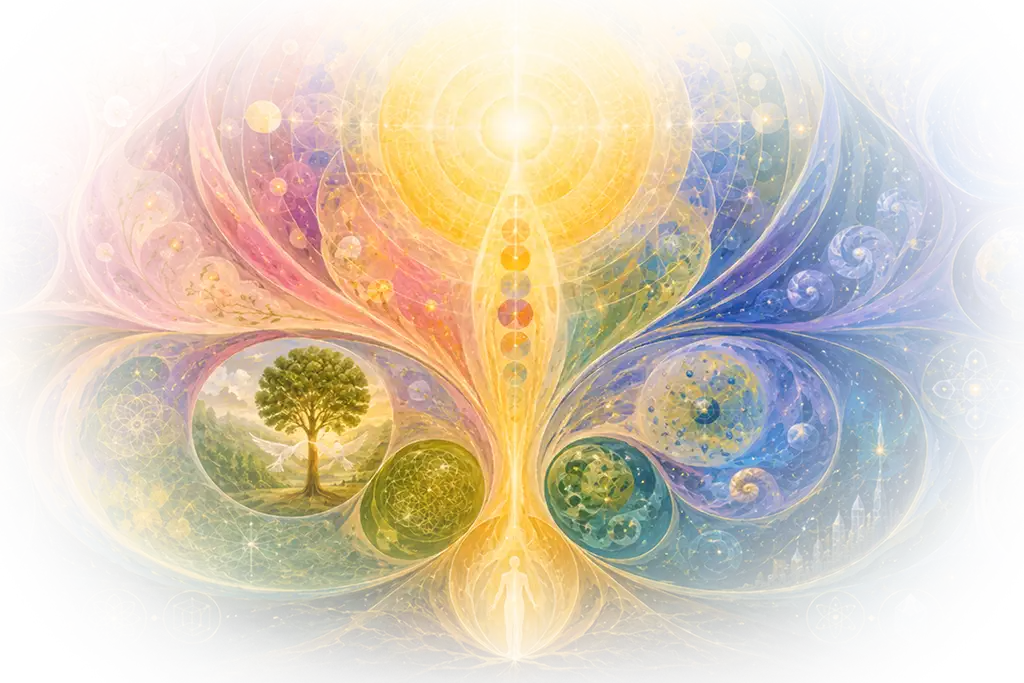
Law Overview
The Law of Mentalism teaches that mind is not merely a private faculty inside the individual, but the primordial field from which worlds, forms, meanings, and destinies arise. Thought is the subtle architecture of manifestation; imagination is the inner temple where the visible is first shaped in the invisible.
In the mystical traditions, this law appears as divine Mind, Logos, Brahman, Kether, Nous, Word, dream, memory, and cosmic intelligence. Each name points toward the same contemplative insight: before a thing becomes matter, event, language, or circumstance, it exists as pattern in consciousness.
To practice Mentalism is to become responsible for the quality of thought, the direction of attention, and the purity of inner vision. The seeker learns that the mind is not a passive mirror of reality, but one of the sacred instruments by which reality is interpreted, invited, and formed.
Historical, Civilizational, and Comparative Analysis
Ancient Roots
Hermetic Egypt
In the Hermetica, the cosmos is understood through the mystery of divine Mind. The famous Hermetic formula associated with the Emerald Tablet declares, “That which is below is as that which is above,” revealing the mind-like correspondence between heavenly pattern and earthly form.
India
In the Chāndogya Upaniṣad, the world arises from the subtle reality of Brahman, the ultimate consciousness behind all appearances. The teaching suggests that creation is not separate from awareness, but unfolds from it like a dream arising within the infinite Self.
Plato
In the Timaeus, Plato presents the visible world as an image of intelligible order. Matter receives form through archetype, and the cosmos becomes a living reflection of divine reason.
Pagan Echoes
Eastern Echoes
The Dhammapada begins with the teaching that all experience is preceded by mind. In Buddhist contemplation, thought does not merely describe suffering or peace; it conditions the path by which suffering or peace is encountered.
“All that we are is the result of what we have thought.”
Dhammapada 1:1
Esoteric Echoes
In Kabbalah, Kether is the crown of divine consciousness, the first emanation from Ein Sof. It represents the primal point of divine intention before the unfolding of worlds, names, and forms.
Here Mentalism appears as the mystery of emanation: the universe descends from concealed unity into knowable structure, and every created thing bears the trace of the first thought.
Christian Echoes
Christian mystical theology expresses Mentalism through the doctrine of the Logos, the divine Word through whom creation comes into being. The Gospel of John places Word, God, and creation in a single mystery of divine utterance.
“In the beginning was the Word, and the Word was with God, and the Word was God.”
John 1:1–3
Notes on Usage, Application, and Practice
Cultivate Mastery of Thought
Meditate Upon Stillness
Recognize the Mirror
See every creation as a reflection of Mind. What appears outside the self may reveal the architecture, distortion, clarity, or holiness of the inner world.
Quotes and Key Statements
-
Hermetic: “That which is below is as that which is above.”
-
Indian: “Brahman is this mind; from this the world arises as from a dream.”
Chāndogya Upaniṣad VI.2.1
-
Platonic: “The world is the visible image of the intelligible.”
-
Buddhist: “All that we are is the result of what we have thought.”
Dhammapada 1:1
-
Christian: “In the beginning was the Word, and the Word was with God, and the Word was God.”
Representative and Definitive Sources
-
Corpus Hermeticum I, “Poimandres”
-
Chāndogya Upaniṣad VI.2.1
-
Gospel of John, King James Version
-
A foundational Platonic source for the world as an image of intelligible order.
-
A central Buddhist source for the primacy of mind in the shaping of experience.
Contemplative Exercise
Sit in silence and observe one recurring thought without judgment. Ask: What world does this thought create? What emotion sustains it? What higher thought could transfigure it?
Then speak inwardly: “Let my mind become clear, that the divine pattern may be known.” Rest in stillness and allow the thought to dissolve into awareness.
Literature, Film, Music, and Cultural References
Literature
-
The Divine Comedy by Dante Alighieri
A visionary ascent through states of consciousness, moral order, and divine intelligence.
-
The Marriage of Heaven and Hell by William Blake
A poetic exploration of imagination as sacred perception and creative fire.
-
A mythic source for the living powers of thought, memory, prophecy, and divine vision.
Film
A modern cinematic allegory of reality as constructed perception and awakened consciousness.
A symbolic meditation on dream, idea, and the power of planted thought.
Music
The Beatles, “Across the Universe”
A contemplative song of thought, mantra, and consciousness flowing through the cosmos.
A meditative reflection on unseen order, unfolding destiny, and the mystery behind appearances.
Law I:
The Law of Mentalism
As Mind conceives, so form receives. As consciousness awakens, the world is remade.